




Every few years, the search industry declares that SEO is dead. It happened when mobile search overtook desktop. It happened when voice search arrived. It is happening again now, with AI-powered search tools such as Google AI Overviews, ChatGPT and Perplexity answering questions directly, without sending a single click to a website.
We do not see it that way. Having managed ecommerce SEO campaigns for online retailers across multiple sectors, our view is more precise: SEO is not being replaced; it is being expanded through AI-driven ecommerce optimization layered on top of what already works. Traditional SEO built the foundation that made a store findable. AI-powered SEO decides whether that store gets mentioned, recommended and trusted by the systems shoppers now use to research and buy. A retailer that treats these as separate disciplines will fall behind. A retailer that treats them as one connected strategy will gain ground on competitors still fighting yesterday’s battle, and will hold on to website visibility for ecommerce businesses even as the search landscape shifts under them.
This article sets out the practical differences between the two approaches, where they overlap, how to implement AI in ecommerce SEO, and how a US-based ecommerce brand can build a strategy that satisfies both.
What Traditional Ecommerce SEO Actually Optimizes For
Traditional ecommerce SEO was built around a simple mechanic: a shopper types a query into Google, and the search engine returns a ranked list of pages. Success was measured by where a product or category page landed on that list.
This discipline still rests on a well-defined set of levers:
- Keyword targeting across product titles, category pages and metadata
- Technical health, including crawlability, indexation, site speed and mobile performance
- On-page structure, such as clear headings, internal linking and unique product descriptions
- Backlink authority, built through outreach, digital PR and citations from relevant sites
- Structured data, including Product, Offer and Review schema that helps Google display rich results
These fundamentals were never about gaming an algorithm. They were about giving a search engine absolutely clear, well-organised information to understand what a page offers and to whom it should be shown. That objective has not gone away. It has simply become the entry requirement for a second, newer layer of competition.
What AI-Powered Ecommerce SEO Adds to the Equation
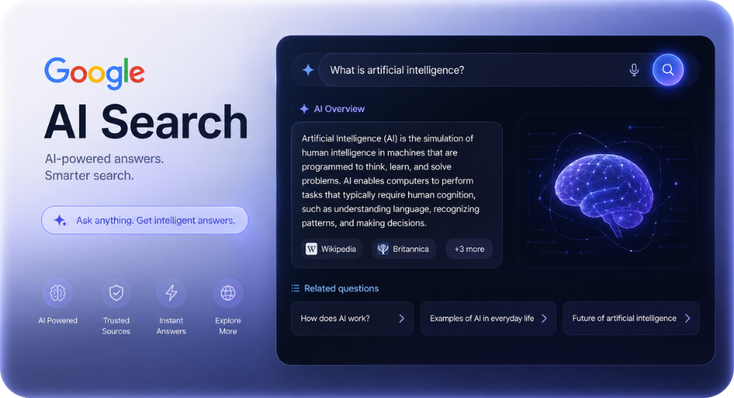
AI-powered search changes the mechanic itself. Instead of returning ten blue links, tools such as Google AI Overviews, ChatGPT and Perplexity generate a direct answer, often naming two or three brands within it. The shopper may never visit a website before forming an opinion of which product to buy.
So how does AI improve ecommerce SEO in practice? It shifts the goal from being found to being trusted enough to be repeated. This shift has produced two related disciplines that our team treats as core service areas rather than passing trends:
- Generative Engine Optimization (GEO): structuring content so AI systems can accurately extract, summarize and cite it. This depends on clear entity definitions, consistent facts across the web, and content that answers the “why” behind a purchase decision, not just the “what.”
- Answer Engine Optimization (AEO): writing content in a format AI systems can lift directly into an answer. Short, direct responses to specific buyer questions, supported by clean schema markup, perform far better here than long, unstructured paragraphs.
The practical difference for a retailer is this: traditional SEO asks, “Does Google understand this page well enough to rank it?” AI-powered SEO asks, “Does an AI system trust this content enough to repeat it as fact?” Those are related questions, but they are not the same question, and they require different work to answer.
The benefits of AI-powered SEO for online stores go beyond a single mention in a chat answer. Done well, it compounds with your existing rankings rather than competing with them:
- Product visibility inside AI answers, not just organic listings, reaching shoppers earlier in their research
- Higher-intent traffic from buyers who arrive already informed, which tends to convert better than early-stage clicks
- Stronger brand authority across the web, since the content and third-party proof required for AI citation also strengthens traditional link building and PR
- A more durable strategy overall, since it is not dependent on any single search engine’s ranking algorithm
Where the Two Approaches Genuinely Differ
Based on the audits and campaigns we run for ecommerce clients, four differences consistently separate traditional SEO work from AI-powered SEO work, and they explain what makes AI different from traditional SEO for ecommerce at a practical level.
1. The unit of competition changes.
Traditional SEO competes for a ranking position on a results page. AI-powered SEO competes for a mention inside a generated answer. A brand can rank on page one for a keyword and still be absent from the AI Overview sitting above it. This is also how AI affects search rankings for ecommerce in a way rank trackers alone will not show you: a page can hold its position and still lose visibility to an AI-generated summary.
2. The content that wins looks different.
Traditional SEO rewarded comprehensive, keyword-rich pages built to satisfy a search engine’s crawler. AI-powered SEO rewards content built to satisfy a specific buyer question, written in plain language, and structured so an AI model can quote it without misrepresenting it. Padding a page with keyword variations does nothing for an AI system evaluating whether your answer is accurate and trustworthy.
3. Authority is measured across the whole web, not just your domain.
A traditional backlink profile focuses on links pointing to your site. AI systems form an opinion of a brand from everything said about it across the web, including reviews, comparison articles, forum threads and press coverage. A retailer with a technically flawless site but no independent third-party coverage will struggle to be cited, regardless of its domain authority.
4. Measurement requires new metrics.
Keyword rankings and organic sessions still matter, but they no longer tell the full story. Ecommerce teams now need to track whether their products are being surfaced or recommended inside AI-generated answers, and whether that visibility is translating into direct traffic, branded search growth or assisted conversions further down the funnel.
Where the Two Approaches Still Depend on Each Other
None of this means traditional SEO fundamentals can be set aside. AI search tools still rely on the same crawlable, indexable web that search engines have always used. If a site cannot be crawled, cannot be indexed, or serves inconsistent product data, it has no chance of being cited in an AI-generated answer, regardless of how well its content is written.
Technical SEO, clean schema markup and a well-structured site remain the entry point. AI-powered optimization is the layer built on top of that foundation, not a substitute for it. Any strategy that skips the fundamentals to chase AI visibility is building on unstable ground.
How to Implement AI in Ecommerce SEO
Moving from traditional SEO to a combined strategy does not require starting over. It is a sequence of additions layered onto what already exists:
- Audit your entity data first. Make sure your brand name, product names, pricing and specifications are stated consistently across your site, marketplaces, review platforms and social profiles. AI systems cross-check facts, and inconsistency is one of the fastest ways to be left out of an answer.
- Rewrite key product and category pages around real buyer questions. Use the actual language customers search with, and answer it directly in the first few sentences before expanding with detail.
- Expand schema markup. Product, Offer, Review and FAQ schema give AI systems a structured, unambiguous source to pull from, rather than asking them to interpret unstructured prose.
- Build genuine third-party coverage. Reviews, comparison articles and press mentions carry more weight for AI citation than they ever did for classic backlink authority alone.
- Introduce automated ecommerce SEO using AI where it removes manual bottlenecks. Tools that flag missing schema, inconsistent product data or thin content across hundreds of SKUs let a team focus its time on the pages and questions that matter most, rather than replacing strategic judgment.
- Monitor and adjust. Test the questions your buyers actually ask inside AI tools, track where you are and are not appearing, and feed that back into the content and data work above.
Best Practices for AI-Powered Ecommerce SEO
Across the campaigns we run, a consistent set of practices separates retailers who gain AI visibility from those who do not:
- Answer one buyer question clearly per section rather than blending several into a single paragraph
- Keep facts about pricing, availability and specifications identical everywhere they appear online
- Use FAQ, Product and Review schema on every page where it genuinely applies, not just the homepage
- Earn independent reviews and coverage rather than relying only on owned content
- Avoid keyword stuffing and repetitive phrasing; AI systems are evaluating trustworthiness, not keyword density
- Revisit and update content regularly, since AI systems favour current, verifiably accurate information over stale pages
Tools That Support AI-Powered Ecommerce SEO
What tools are available for AI ecommerce SEO depends on which part of the process you are trying to strengthen:
- AI visibility and citation tracking: tools that test how brands and products appear across AI Overviews, ChatGPT and Perplexity for a defined set of buyer questions
- Schema and structured data tools: generators and validators that keep Product, FAQ and Review markup accurate and error-free at scale
- Content and entity consistency tools: platforms that flag mismatched product facts across a site, marketplaces and third-party listings
- Traditional SEO platforms: rank trackers, crawlers and analytics tools remain necessary, since AI visibility is built on top of technical SEO health, not instead of it
No single tool covers all of this end to end today, which is why most retailers combine a few of the above with hands-on content and data work rather than relying on one platform alone.
A Practical Example
Consider a Texas-based outdoor furniture retailer selling nationally, with its strongest customer bases in New York, California and Florida. Under a traditional SEO approach, this retailer would target keywords such as “patio furniture sets” and “outdoor dining sets,” build category pages around them, and pursue backlinks from home and garden publications.
An AI-powered approach builds on that same foundation but adds specific work: product pages written to directly answer questions such as “what patio furniture holds up best in Florida humidity” or “best outdoor furniture materials for California sun exposure,” supported by Product and FAQ schema, and reinforced by genuine customer reviews and independent coverage that AI systems can draw on to confirm those claims. When a shopper in Miami asks an AI assistant which patio set resists humidity damage, this retailer’s product is positioned to be part of that answer, not just a link buried on page two of a traditional search result.
The keyword research, the technical build and the schema markup are shared work. The difference lies in writing content that answers real questions in plain language, and in building the outside credibility that lets an AI system trust the answer enough to repeat it.
Same expertise, every industry. The approach in this article — technical SEO fundamentals layered with AI-driven visibility — is exactly how we structure campaigns for every sector we serve, including home services.
See Our HVAC Digital Marketing Services →
Common Questions We Are Asked
Is AI-powered SEO replacing traditional SEO?
No. AI-powered SEO is built on top of traditional SEO fundamentals. A site with poor technical health or thin content will not succeed in either environment.
Is traditional SEO still important after AI mode?
Yes, traditional SEO is still important after AI mode. AI search tools and generative overviews do not replace search indexes; instead, they rely on traditional technical optimization, high-quality content, and website authority to crawl, verify, and source their answers.
How do Ecommerce businesses use AI for SEO?
Scale content creation, optimize technical performance, and win placements in generative search engines and chat-based shopping assistants.
What are the best AI SEO platforms for ecommerce?
The best AI SEO platform for ecommerce depends on your specific goal. But according to us for all-in-one visibility tracking across traditional search and AI engines like ChatGPT and Google AI Overviews, Semrush is the top overall choice. For optimizing product descriptions and category page content at scale, Surfer SEO is the strongest option.
What do you mean by AI SEO strategy for ecommerce brands?
An AI SEO strategy for e-commerce means optimizing your online store for generative search engines, AI Overviews, and conversational shopping assistants.
Do I need to abandon my current SEO strategy to focus on AI search?
No. The correct approach is to strengthen the technical and content foundation that already exists, then layer in the structured data, direct-answer content, and third-party credibility that AI systems require.
Is SEO dead for ecommerce now that AI answers purchase questions directly?
SEO is not dead for e-commerce, but it has changed. AI tools now answer basic product questions directly on search pages. However, shoppers still visit traditional search engines and retail sites to compare products, read deep reviews, and make final purchases.
How do I know if my products are appearing in AI-generated answers?
This requires monitoring tools built for AI visibility, alongside manual testing of the questions your customers are likely to ask. Standard rank-tracking tools were not built to measure this, which is why it is often missed.
Does this apply to smaller ecommerce businesses, or only large retailers?
It applies to any retailer competing for buyer attention online. Smaller brands often move faster here, since AI systems reward clear, well-structured, credible content over sheer size or budget.
Will my traffic keep declining as AI search grows?
Traffic patterns are shifting, not simply shrinking. Some research-stage traffic is being absorbed into AI-generated answers, while well-positioned brands are seeing an increase in high-intent, later-stage traffic from shoppers who arrive already informed. The retailers losing ground are typically the ones making no changes at all.
Is AI-powered SEO worth the investment for ecommerce?
For most retailers, yes, provided the fundamentals are already in place. The cost is largely the content, data consistency and schema work described above, and it strengthens traditional rankings at the same time as it builds AI visibility. It is not worth pursuing in isolation on a site with poor technical health, since neither system will trust content it cannot properly crawl or verify.
Are there risks associated with AI ecommerce SEO?
The main risk is treating it as a shortcut rather than an extension of sound SEO. Chasing AI citation with thin, unverified or inconsistent content can damage trust with both AI systems and shoppers. There is also less direct control over how and when a brand is cited compared with a ranking position, so measurement needs to account for visibility that does not always convert into a click.
Where This Leaves US Ecommerce Retailers
The retailers that will win the next few years of search are not the ones abandoning SEO for something new. They are the ones treating traditional SEO and AI-powered SEO as a single, connected discipline: a technically sound, well-structured site, supported by content that answers real buyer questions, and reinforced by genuine authority across the web.
This is the approach we bring to every ecommerce client, combining full-service digital expertise with the AI-driven strategies now shaping how buyers discover and choose products. If your store is built for how people searched five years ago, it is time to rebuild it for how they are searching now.
Ready to Scale with a Team That Already Gets It?
From automation to data-driven strategy, our digital marketing services are built for businesses that want growth, not just clicks.